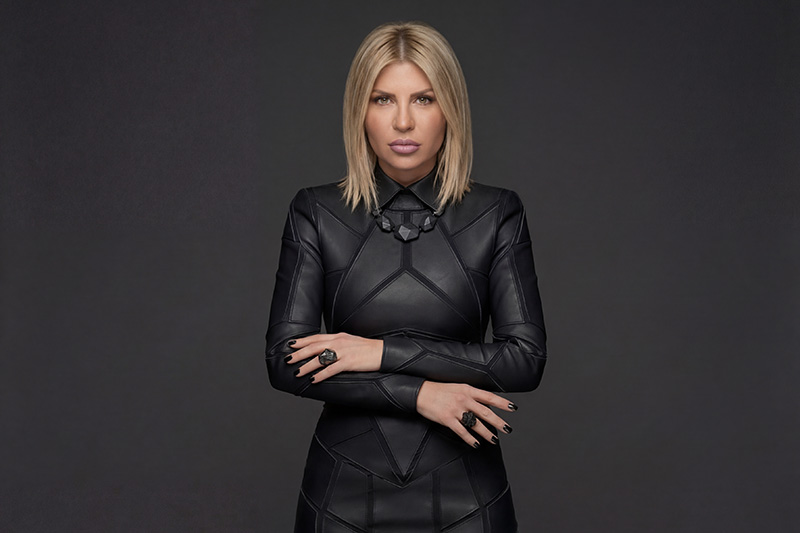
Amymi Musica has spent years releasing music on established labels — but Distorted Thoughts marks something different. It is the debut release of UnGenre Records, her own label, built around a simple idea: that some artists don’t belong in one box, and shouldn’t have to pretend otherwise. We spoke with her about the label, the sound, and what comes next.
Amymi UnGenre Records launched alongside your debut release. How long had the idea of starting your own label been on your mind before it became an actual plan?
This is not my debut release in general — I have been releasing music for quite a long time on established and respected labels. Distorted Thoughts represents the debut release of UnGenre Records, which is a very different kind of milestone for me.
The idea of starting the label came from a combination of experiences over the years. After organising and being involved in underground parties for a long time, I started to see a clear need for a platform that goes beyond just events — a space where the same energy and philosophy could continue through music releases.
There were several reasons behind this decision, but one of the most important was the desire to open doors for other artists and create opportunities, especially for those who are trying to enter the industry and don’t necessarily fit into a label’s sound. I wanted to build something that reflects the reality of the underground scene: diverse, evolving, and driven by rhythm rather than trends. We will create the trend, not follow it.
The idea became more concrete about six months ago, especially during the Amsterdam Dance Event 2026. Being there, having conversations, and observing the industry from a wider perspective gave me the final push and confidence to turn this into an actual plan. So launching Distorted Thoughts on UnGenre Records felt like the right way to begin — not as a first step in my career, but as the first statement of a new chapter.
The name UnGenre is a clear statement. Do you think the genre system in electronic music has genuinely broken down, or did it never really serve artists like you in the first place?
For me, UnGenre is not about rejecting genres in the traditional sense — it’s about going beyond them. Genres still have their place in the industry, especially for structure and navigation, but they don’t always reflect how artists truly create.
UnGenre represents the idea that an artist can develop a personal sound by merging different styles in a very intentional and refined way, depending on emotion, context, and energy — whether that translates into higher energy, a slower groove, or something in between. It’s more about identity than category.
Some artists don’t naturally belong to one lane, and forcing that can limit their expression. With UnGenre Records, the goal is to open the door for those artists — to give space to creators who want to move across genres while still maintaining a strong and coherent artistic sound.
So it’s not that the genre system is broken — it’s that it was never designed to fully support this kind of fluid, hybrid expression. UnGenre exists to support that space in between, where emotion, rhythm, and individuality come first.
You’ve said it felt more honest to build your own platform rather than try to fit into existing ones. Were there specific moments or experiences that pushed you toward that decision?
Yes, there were definitely specific moments that pushed me in that direction. One of the main realisations came from observing other successful artists in the scene — how they were able to grow faster and more authentically by building their own brand and having a clear identity across all platforms and releases. I started to understand that having your own platform is not just about control, but about consistency. When everything — your sound, your visuals, your message — comes from the same place, it creates a stronger connection with the audience and a clearer artistic direction.
At the same time, I want to be very clear that I have never felt unwelcome by any label because of my creativity — on the contrary, the labels I have worked with have always embraced my sound and supported my direction. That’s something I truly value, and I need to continue releasing with them, as well as with other established labels moving forward.
UnGenre Records is not a replacement for that — it’s an extension. It’s a space where I can explore a different side of my identity, release music that might not always fit within a specific framework, and create something with a distinct philosophy.
Distorted Thoughts was built on an analog sequencer at 135 BPM. Can you walk through the production process and explain what drew you toward a more hardware-driven approach rather than working entirely in the box?
For me, the process usually starts on hardware before moving into the DAW. With Distorted Thoughts, I began building the idea using machines like the TR-8 for drums, then shaping the bassline with the TD-3, modulated through the Model D to give it more depth and movement. From there, I moved into the synth layers using the Crave, adding textures and filtering, and refining elements with the MicroFreak. I like to build in groups — starting with drums, then bass, then synths — so the track develops in a very physical and rhythmic way from the beginning. Once the core idea is there, I transfer everything into Ableton Live where I arrange the track, structure the energy, and handle the mixdown. The mastering was then finalised with Audio 3K.
The reason I am drawn to hardware is very instinctive. I have always been passionate about analog and modular gear, which is also why I spent every year attending workshops during the Amsterdam Dance Event — to understand how artists interact with machines and develop their live performance skills. That was actually my initial goal: to improve my live setup and performance approach.
Hardware gives me a different kind of connection to the sound. It feels more immediate, more tactile, and in a way more personal. The imperfections, the modulation, the hands-on control — it creates something that feels alive. It’s also simply more fun and expressive compared to starting entirely in a DAW.
That’s why I like blending both worlds. Sometimes I start with hardware and move into digital; sometimes I combine both from the beginning. For me, it’s not about choosing one over the other — it’s about using whatever allows the idea to come through in the most authentic way.
The track sits across Techno Peak Time, Driving, Raw, Deep, and Hypnotic on Beatport. Is that kind of cross-category placement something you aim for intentionally, or is it just a natural result of not thinking in genres while you produce?
Yes, in this case it’s intentional. I am very attracted to both sides of that spectrum — the hypnotic, deeper elements and the more driving, peak-time energy. On the dance floor, I find it powerful when a track can hold that tension: something that pulls you into a hypnotic-like state while still pushing you forward with strong energy and momentum.
When I was producing Distorted Thoughts, I wasn’t thinking in terms of fitting into one category, but I was consciously shaping that balance. I wanted the groove to be immersive and repetitive in a hypnotic way, while the drums and structure keep it energetic and impactful for peak-time moments.
So the cross-category placement reflects that intention. It’s not about blending genres randomly, but about designing a specific feeling where depth and drive exist at the same time, and the track can work both emotionally and physically on the dance floor.
You’ve mentioned opening UnGenre to other artists eventually, but only those who don’t fit neatly into one box. What does that mean in practice — a specific sound, a mindset, or something else entirely?
For me, it’s less about a specific sound and more about a mindset. What I am looking for are artists who don’t follow trends or hype, but instead take the time to build their own identity and brand — artists who are willing to experiment, to work outside the usual structures, and create something that reflects who they are rather than what is currently popular.
Today, especially with the new generation, it’s very common to hear tracks built from the same templates and sample packs. Technically, they can be clean, but often they lack identity, depth, flow, and emotional impact. Everything sounds very “modern,” but not necessarily memorable or meaningful — you don’t always feel something that stays with you.
With UnGenre Records, the idea is to move away from that. It’s about giving artists the freedom to create the sound they truly connect with, without feeling the need to copy or fit into a formula.
So in practice, it’s not about creating a new track — it is about supporting a way of thinking. A creative mindset where originality, emotion, and individuality come first.
Events are part of the label’s longer-term vision. How important is the live and club context in shaping what you want UnGenre to become?
The live and club context is essential to what we want UnGenre Records to become. For us, everything starts from the dance floor. The way a track is felt in a club — the energy, the reaction, the connection between people — that’s the real test. It’s where music becomes alive, not just something you listen to, but something you experience physically and collectively.
Having organised underground events before, we have seen how important that environment is in shaping both artists and sound. It’s not just about playing music — it is about creating a space where people can disconnect, feel free, and connect through rhythm.
That’s why events are a natural extension of the label. UnGenre is not only about releasing music, but about building a full ecosystem where the sound, the artists, and the audience all interact in a real setting. In the long term, we want the label to exist both as a sonic identity and as a physical experience — where what you hear in a track translates directly into what you feel on the dance floor.
Launching a label is a very different commitment from releasing music. What would UnGenre need to achieve in its first year for you to feel like it has been worth the leap?
For UnGenre, success in the first year is not defined only by numbers or chart positions — it’s about establishing a clear identity, direction, and connection.
What we want to achieve first is consistency: releasing music that truly reflects the philosophy of the label — rhythm-driven, emotionally honest, and not confined to one genre. If people start to recognise a certain feeling or signature when they hear an UnGenre release, then we know we are on the right path.
Another important goal is building trust with both artists and listeners. We want artists to feel that this is a space where they can express themselves freely without needing to follow trends, and for listeners to connect with the music on a deeper level — not just as something functional for the dance floor.
It would also be important to start introducing new talent — artists who might not yet have a strong platform, but have a unique voice. Giving them visibility and helping them enter the scene is a big part of the vision.
And finally, even at an early stage, beginning to connect the label with real experiences through events or curated moments would make it feel complete. Because for us, the label is not only about releasing tracks, but about building a community and a movement around a shared way of experiencing music.
If by the end of the first year UnGenre has a clear identity, a small but strong roster, and a genuine connection with its audience, then it will absolutely feel like the right step.